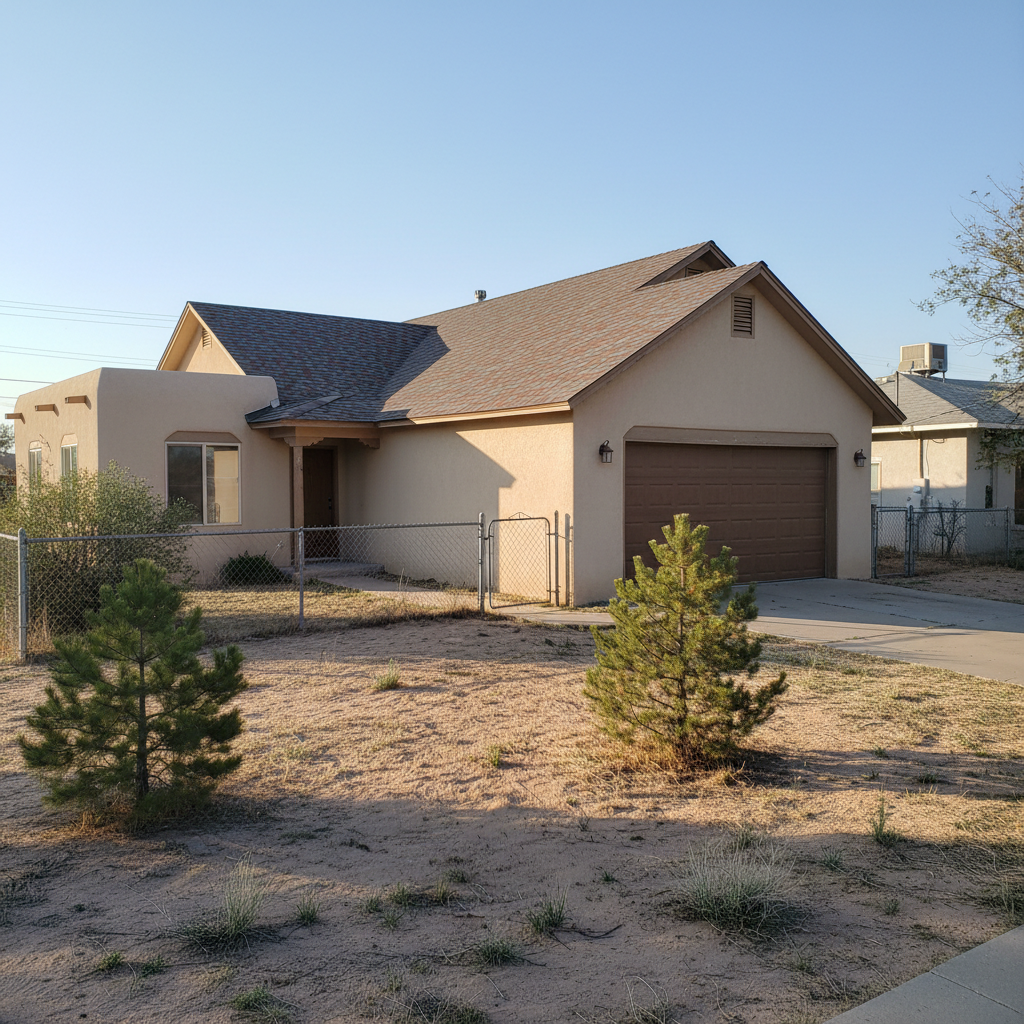
Sunland Park sits in a strip of desert where the roofing stock is split between two very different builds. Older sections and some of the colonia-adjacent streets have flat or low-slope roofs, built that way because this region gets maybe 9 inches of rain a year and a pitched roof wasn't worth the lumber. Newer subdivisions near Santa Teresa and the areas pushing toward the Border West Expressway went up with standard comp shingle roofs on conventional truss framing, the same as you'd see in El Paso. A contractor who only knows one of those two systems is going to steer you toward what they know, not what your house actually needs.
That matters before you even get to price. Here's what actually separates a roofer worth hiring from one you'll be calling back in two years.
Check the license the right way
New Mexico requires a state contractor's license through the Regulation and Licensing Department, and roofing falls under a specific trade classification, not the general contractor's license some guys will wave at you. Ask for the license number and look it up yourself on the RLD website rather than taking a business card's word for it. You want to see it's current, not expired, and that there haven't been complaints filed against it. Ask for proof of liability insurance too, and get the certificate emailed to you directly from the insurer, not a photocopy the contractor hands you. A roofer who hesitates on either of those two things is telling you something.
How they inspect matters more than what they quote
A real inspection means someone gets on the roof, not just stands in the driveway with binoculars. On a shingle roof they should be checking for cracked or lifted tabs, nail pops, and soft spots in the decking where the plywood or OSB has delaminated from water getting under old flashing. On a flat roof they're looking at the membrane seams, ponding spots that hold water more than 48 hours after a storm, and whether the base flashing at parapet walls and roof penetrations is still sealed. If someone quotes a full roof replacement off a photo from the ground or a satellite image, get a second opinion. Hail damage especially is easy to miss unless you're looking at the actual granule loss on a test square of shingle, and underestimating it either way costs you.
Materials have to match the climate, not just the budget
This part of New Mexico runs over 300 sunny days a year, and UV breaks down roofing materials faster than people expect. A three-tab shingle rated for 20 years in a milder climate might give you 15 here because the sun is baking the asphalt oils out of it every single day. Architectural shingles with a higher wind rating are worth the upcharge, because spring brings sustained wind events and dust storms off the flats that will peel back a poorly nailed shingle in one afternoon. On flat roofs, a white or reflective TPO membrane, or a silicone roof coating, cuts down on heat absorption a lot more than a dark modified bitumen cap sheet, and it slows the UV breakdown too.
Monsoon season, roughly July through September, is the other thing to plan around. It doesn't rain much here, but when it does it comes down hard and fast, and a roof with poor drainage or clogged scuppers will back water up against a parapet wall in twenty minutes. Any contractor working on a flat roof here should be talking to you about slope and drainage, not just the membrane itself.
Permits and inspections aren't optional, even if a contractor tells you they are
A full roof replacement in Sunland Park requires a building permit, and the inspection typically covers the decking once the old roofing is torn off, the underlayment, and the final flashing and ventilation work before it's signed off. If your property sits in city limits, that permit runs through the City of Sunland Park; if you're just outside it, Doña Ana County handles it. Either way, a contractor who tells you permits are a waste of time or money is telling you they don't want an inspector looking at their work. That should end the conversation right there. On older homes, especially ones built or added onto before current code, a permit pull is also when problems like undersized rafters or non-compliant venting get caught, before they turn into a bigger repair.
Get it in writing, and read the warranty terms twice
A written estimate should spell out the materials by brand and product line, the number of layers being removed, whether decking replacement is included or billed separately if they find rot, and a payment schedule. A deposit up front is normal. Full payment before the work starts is not. Most legitimate roofers ask for a third down, progress payments, and the balance on completion after you've walked the roof with them.
Warranties come in two separate pieces and a lot of homeowners don't realize that until there's a problem. The manufacturer's warranty covers defects in the shingles or membrane itself. The workmanship warranty, which the contractor provides separately, covers their installation. A 30-year shingle with a 2-year workmanship warranty from the installer is a mismatch worth asking about.
The red flags that mean you walk away
- Door-knocking right after a hailstorm, offering a free inspection and a same-day contract
- No local address or a phone number that only ever goes to voicemail
- Pressure to sign before you've gotten a second quote
- A quote that's dramatically lower than two others for the same scope of work
- Refusing to pull a permit, or telling you it isn't required for your job
None of these on their own is automatic proof of a bad contractor, but two or three together is enough reason to call someone else. Roofing in this part of New Mexico has its own set of problems, between the sun load, the wind, and the short violent rain events, and the contractor you hire should already know that before they ever get on your roof. If you're weighing a repair against a full replacement, or just want a straight answer on what your roof needs, that's the kind of walk-through we do as Orbit Roofing Company.